

 Diary: Friday, 05-18-2018 || Heavy Rain, Floods, Escape to Vyoon's. A noisy storm released downpours, lightning, premature darkness, and a reluctance to leave the radio studios for home.
After taking a nap in my office and watching the progress of the rain on our news department's radars and reports from Channel Four's forecasters, I came up with a more interesting idea. After checking to make sure it was open, my umbrella and I made our way to Vyoon's, the new restaurant around the corner from the studio. There I found owners ZouReh Khaleghi and Vyoon Segue, sitting at the chef's table and seating a handful of customers. Like me, they are delighted to get out of the rain and storm. Especially since the successful Eat Club dinner we had here earlier in the week.
I thought about getting another bite of the roasted scallops and the golden beet salad we had for the Eat Club. My entree now, encouraged by ZohReh, was one of the monster size soft-shell crabs that she says just arrived for the first time this year. This is everthing I want from a soft-shell crab, along with a brown-butter bread-crumbliness, a local origin, and general toastiness.
The crab and more of the saffron ice cream we had at the Eat Club dinner finished this dinner. By then, although there were some deeply-flooded patches around the city, I figured I could make a run for home, and indeed manage to avoid all danger zones. But it took me--counting the dinner--four hours to get home.
Vyoone's. CBD: 412 Girod St. 504-518-6007.
[divider type=""]
Mattina Bella Saturday-05-19-2018 || I begin the by having breakfast, of course. Mattina Bella's kitchen made up one of my ideas, a pair of poached eggs atop some thinly-sliced tomatoes and Italian sausage, with a couple of tablespoons of marinara sauce mingling with the hollandaise going over the top. (And it was indeed over the top in the other sense of the phrase.)
As if that weren't already enough to eat, they show me a new item: French toast topped with blackberries. It would later adjust my ideas for dinner.
The day is calmed down a bit by my not having to host a radio show. This allows me to take an hour-long walk around the Cool Water Ranch, and to follow that with a nap. Nice combination.
Mary Ann wants to attend the LPO's Carmina Burana concert tonight at the Orpheum. MA's sister Sylvia joins us both for the performance and for supper. For the latter we drive over to Borgne, where we have had much good luck lately. But nobody is particularly hungry. The girls find the big roasted oysters too big, and I get almost all of them. (The bigger the oyster, the more I like it.) We also have crawfish bisque, but it's more like a she-crab soup, or like a French bisque. Nothing wrong with any of that, unless what you were expecting was dark-roux Cajun flavors.
Mary Ann reconnoiters nearly the entire premises of the Orpheum, looking for seats better than the ones we bought. This is usually easy, but the concert is very well attended. This does not stop for MA's quest for the ideal seats.
All the time I sweat out the dubious spot where MA parked her car. But her magic in parking leaves the car, unticketed and untowed, right where we left it. So winds up a great evening.
Borgne. CBD: 601 Loyola Ave (Hyatt Regency Hotel). 504-613-3860. [divider type=""]
Diary: Friday, 05-18-2018 || Heavy Rain, Floods, Escape to Vyoon's. A noisy storm released downpours, lightning, premature darkness, and a reluctance to leave the radio studios for home.
After taking a nap in my office and watching the progress of the rain on our news department's radars and reports from Channel Four's forecasters, I came up with a more interesting idea. After checking to make sure it was open, my umbrella and I made our way to Vyoon's, the new restaurant around the corner from the studio. There I found owners ZouReh Khaleghi and Vyoon Segue, sitting at the chef's table and seating a handful of customers. Like me, they are delighted to get out of the rain and storm. Especially since the successful Eat Club dinner we had here earlier in the week.
I thought about getting another bite of the roasted scallops and the golden beet salad we had for the Eat Club. My entree now, encouraged by ZohReh, was one of the monster size soft-shell crabs that she says just arrived for the first time this year. This is everthing I want from a soft-shell crab, along with a brown-butter bread-crumbliness, a local origin, and general toastiness.
The crab and more of the saffron ice cream we had at the Eat Club dinner finished this dinner. By then, although there were some deeply-flooded patches around the city, I figured I could make a run for home, and indeed manage to avoid all danger zones. But it took me--counting the dinner--four hours to get home.
Vyoone's. CBD: 412 Girod St. 504-518-6007.
[divider type=""]
Mattina Bella Saturday-05-19-2018 || I begin the by having breakfast, of course. Mattina Bella's kitchen made up one of my ideas, a pair of poached eggs atop some thinly-sliced tomatoes and Italian sausage, with a couple of tablespoons of marinara sauce mingling with the hollandaise going over the top. (And it was indeed over the top in the other sense of the phrase.)
As if that weren't already enough to eat, they show me a new item: French toast topped with blackberries. It would later adjust my ideas for dinner.
The day is calmed down a bit by my not having to host a radio show. This allows me to take an hour-long walk around the Cool Water Ranch, and to follow that with a nap. Nice combination.
Mary Ann wants to attend the LPO's Carmina Burana concert tonight at the Orpheum. MA's sister Sylvia joins us both for the performance and for supper. For the latter we drive over to Borgne, where we have had much good luck lately. But nobody is particularly hungry. The girls find the big roasted oysters too big, and I get almost all of them. (The bigger the oyster, the more I like it.) We also have crawfish bisque, but it's more like a she-crab soup, or like a French bisque. Nothing wrong with any of that, unless what you were expecting was dark-roux Cajun flavors.
Mary Ann reconnoiters nearly the entire premises of the Orpheum, looking for seats better than the ones we bought. This is usually easy, but the concert is very well attended. This does not stop for MA's quest for the ideal seats.
All the time I sweat out the dubious spot where MA parked her car. But her magic in parking leaves the car, unticketed and untowed, right where we left it. So winds up a great evening.
Borgne. CBD: 601 Loyola Ave (Hyatt Regency Hotel). 504-613-3860. [divider type=""]

Pasta Bordelaise
The Italians call this pasta aglio olio. In New Orleans, it's pasta bordelaise, even though there's not a drop of red Bordeaux in it. We eat it as a side dish to all sorts of things, from stuffed crabs to panneed veal. We also make a batch of it around our house when nobody has a strong idea what they want to eat. During the years before our children left home, "garlicky pasta" (our name for the dish) was without question the most popular dish at the Cool Water Ranch. The four of us shared a love for a lot of garlic, even when the kids were little. [caption id="attachment_38532" align="alignnone" width="480"]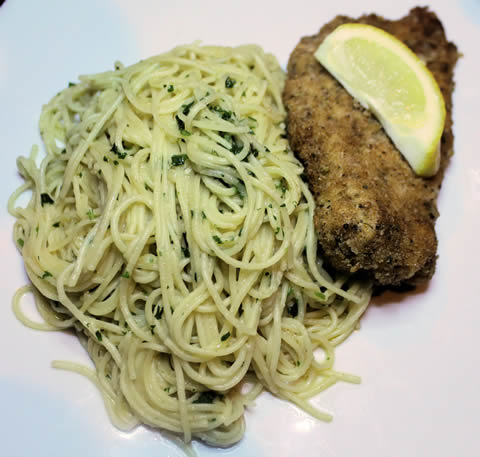 Angel hair bordelaise with panneed veal.[/caption]
- 1 pound angel hair pasta
- 1/3 cup extra-virgin olive oil
- 4-8 cloves garlic, chopped
- 6 sprigs parsley, leaves only, chopped
- 1/4 tsp. crushed red pepper
- 1/4 tsp. oregano
- 1/4 tsp. salt
1. Bring a large pot of water to a rolling boil with a tablespoon of salt dissolved in it. Cook the pasta for about four minutes, leaving it "al dente"--firm to the tooth. Drain the pasta, but save about 1/4 cup of the water.
2. Heat the olive oil in a large skillet until it shimmers. Add the other ingredients except the pasta and cook until the garlic smells good.
3. Add the reserved water from the pasta pot (3 or 4 Tbs.) and whisk to blend.
4. Turn the heat off and add the pasta, tossing it with a fork to coat with the sauce.
5. Divide among the plates and serve with grated Parmigiano Reggiano cheese, or Grana Padano.
Serves four main courses or eight sides.[divider type=""]
 May 23, 2017
Days Until. . .
New Orleans Wine And Food Experience Wine Dinners Begin Tonight Greek Festival Friday Evening, 25
Today's Flavor
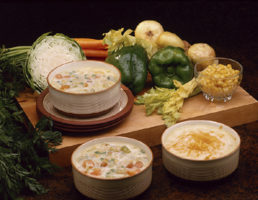
It is Corn and Crab Soup Day. That combination has been around in Chinese restaurants for who knows how long, in the usual thin style common to most Asian soups. But that's not the soup the name conjures up around New Orleans. A rich, spicy potage came to light during Paul Prudhomme's tour of duty as chef at Commander's Palace, in the late 1970s. That soup had the two namesake ingredients in a matrix of reduced heavy cream and crab stock, with a good shake of cayenne pepper to make it convincing.
Food Patents
The Patent Act of 1930 made it possible for plants to be patented. This gave the seed companies a tremendous boost, largely at the expense of the individual farmer and the consumer. If a seed company developed a new corn hybrid, for example, it could now forbid farmers from just replanting the corn using the kernels from last year's crop. Although this was seen as a boon to the creation of new, much more productive hybrids, it also had the unintended effect of narrowing the gene pool for corn. The jury is still out on this one, but it's highly questionable whether in the long run this will prove to have been a good thing for anyone but the three gigantic companies that control corn.
Gourmet Gazetteer
Antelope is a ranch town in north central Texas, ninety miles northwest of Fort Worth. It acquired a post office before the Civil War, and prospered until it reached a population of 300, in 1900. From there it shrank to its present constituency of 65 people, a process that accelerated after the main highway was built a mile north. Antelope is not well fixed with dining possibilities. The nearest is 24 miles east in Bowie: Mancillas Taqueria. If it serves antelope, that will be the best thing on the menu.
The Old Kitchen Sage Sez:
Crabs don't eat corn
And corn's not for crabs
But when the cob's shorn
And lump's up for grabs
Put cream in the pot
And simmer it down
Add cayenne--not a lot
Then just go to town.
Edible Dictionary
pastry cream, n.--A very light custard, resembling a fluffy pudding. It's most often used as a filling in a sweet pastry, such as eclairs or creampuffs. Made with milk, eggs, sugar, vanilla and butter, it's cooked in a saucepan first, then whisked until it gets a very light texture. The critical step in making it is to refrigerate it quickly, because it has a propensity for spoiling or worse. Right before using, you whisk it to make it lighter still. It's not bad all by itself, with some fresh berries or other fruits.
Deft Dining Rule #548
Before ordering chowder in any restaurant, demand to know everything in it, and what color it is. And ask this: Not canned, right? Watch the server's eyes when you ask this.
Music To Chew Gum By
One of the worst songs ever to top the music charts did so on this day in 1968. It was the outer limits of bubblegum music: Yummy Yummy Yummy, by the Ohio Express.
Food Namesakes
Seabiscuit, the famous racehorse, was born today in 1933. . . Early baseball pro Zack Wheat was born today in 1888.
Words To Eat By
"I wish I had time for just one more bowl of chili."--Kit Carson, a cowboy who, according to legend, spoke these words with his dying breath on this date in 1868.
Words To Drink By
There's alcohol in plant and tree.
It must be Nature's plan
That there should be in fair degree
Some alcohol in Man. --A. P. Herbert, British humorist.

The Heavy Philosophy Of Gourmet Cuisine.
The way it happens is this: The pleasures derived from cooking and eating come from a strong effort on the thinker's part, which will build upon what has been thought through and made whole. . .Click here for the cartoon.