

 The Future Of Restaurant Criticism.
This article originally was prepared to appear in the NOMenu Daily a few days ago, when a computer glitch made the whole article disappear. It was almost as if it were trying to tell me something. A lot of people wrote me, asking me what the deal was. Simply, it speaks for itself. But it's not announcing my exit from the profession. I don't expect to check out of this enterprise anytime soon. Sorry if you find it puzzling.--Tom Fitzmorris.
It's easy to get a swelled head when you stay in the same occupation for a long time. Sometimes I think you don't even need to be all that good at the job in question to be regarded highly. In the past few years, the expansion of the importance of food in the media and media in the food has grown to an almost laughable level. That would be about the level that I hoped I would attain thirty years ago. In those days and well before them, I wrote and spoke on my subject as if I were really as important as I was trying to become.
In recent years, though, it seems as my dream come true is already in the twilight of a lackluster career. I don't have the ability to do all of what I once did. I just can't eat that much without killing myself. I don't go to wine tastings any more. It would be anathema for me to host Eat Club dinners--perhaps my best idea ever--any more often than once every month or so. (We used to hold them weekly.)
And yet I keep hearing the praise. At the recent Best Chefs of Louisiana, I was master of ceremonies. But one famous chef after another sought me out to tell me flattering things about my work. It was to laugh, because real chefs and restaurateurs are incomparably more important and interesting than a guy like me. But then a very famous and important chef stepped up to tell me that next year I will be the top honoree. Unbelievable!
I recently got a call from a professor at UNO who I know from having run into him right after Katrina in Washington D.C. Today, he tells me that he's working on an academic project whose point is--if I understood him right--the importance of restaurant critics in the culture of America.
Who, me? The idea sounds good, because it would inflate my image and my work. I have to say that it sounded interesting. Sure, I'll help with it. But I just don't want to make chefs' and restaurateurs' work diminish even slightly in comparison with their much less difficult assignments.
On the other hand, I wouldn't mind having my thoughts turned into theorems. Or having a few more dishes named for me, even though it won't improve any meals. But the real restaurant people are likely laughing at these thoughts of mine.
My UNO colleague thought lunch would be a great place for us to discuss all this. I suggested Trenasse, the café in the Hotel Inter-Continental. My theories about this restaurant have proved solid. if I say so myself. You want to start with as many different oyster dishes as you can stand. My dinner companion had a dozen raw. I tried some new recipes from the baked and grilled part of the oyster bar. Then I shifted to one of the several fish of the day. It is sheepshead, which I order every time I encounter it anywhere. We spent about $80 each on this, and discussed the various prospects that came up for about three hours.
The Future Of Restaurant Criticism.
This article originally was prepared to appear in the NOMenu Daily a few days ago, when a computer glitch made the whole article disappear. It was almost as if it were trying to tell me something. A lot of people wrote me, asking me what the deal was. Simply, it speaks for itself. But it's not announcing my exit from the profession. I don't expect to check out of this enterprise anytime soon. Sorry if you find it puzzling.--Tom Fitzmorris.
It's easy to get a swelled head when you stay in the same occupation for a long time. Sometimes I think you don't even need to be all that good at the job in question to be regarded highly. In the past few years, the expansion of the importance of food in the media and media in the food has grown to an almost laughable level. That would be about the level that I hoped I would attain thirty years ago. In those days and well before them, I wrote and spoke on my subject as if I were really as important as I was trying to become.
In recent years, though, it seems as my dream come true is already in the twilight of a lackluster career. I don't have the ability to do all of what I once did. I just can't eat that much without killing myself. I don't go to wine tastings any more. It would be anathema for me to host Eat Club dinners--perhaps my best idea ever--any more often than once every month or so. (We used to hold them weekly.)
And yet I keep hearing the praise. At the recent Best Chefs of Louisiana, I was master of ceremonies. But one famous chef after another sought me out to tell me flattering things about my work. It was to laugh, because real chefs and restaurateurs are incomparably more important and interesting than a guy like me. But then a very famous and important chef stepped up to tell me that next year I will be the top honoree. Unbelievable!
I recently got a call from a professor at UNO who I know from having run into him right after Katrina in Washington D.C. Today, he tells me that he's working on an academic project whose point is--if I understood him right--the importance of restaurant critics in the culture of America.
Who, me? The idea sounds good, because it would inflate my image and my work. I have to say that it sounded interesting. Sure, I'll help with it. But I just don't want to make chefs' and restaurateurs' work diminish even slightly in comparison with their much less difficult assignments.
On the other hand, I wouldn't mind having my thoughts turned into theorems. Or having a few more dishes named for me, even though it won't improve any meals. But the real restaurant people are likely laughing at these thoughts of mine.
My UNO colleague thought lunch would be a great place for us to discuss all this. I suggested Trenasse, the café in the Hotel Inter-Continental. My theories about this restaurant have proved solid. if I say so myself. You want to start with as many different oyster dishes as you can stand. My dinner companion had a dozen raw. I tried some new recipes from the baked and grilled part of the oyster bar. Then I shifted to one of the several fish of the day. It is sheepshead, which I order every time I encounter it anywhere. We spent about $80 each on this, and discussed the various prospects that came up for about three hours.
 Best concept: noting that I represent the second generation of restaurant critics. The first was Craig Claiborne, Richard Collin, and a few others writing in the 1960s. The third generation never really got off the ground, but the fourth--the one that wondered whether it would have a job after Katrina--did put a restaurant review in every post-K magazine. Nobody has moved in on my radio turf--in this, I am pretty much unique in the world.
I'll end by noting how boring the past few paragraphs are to read. Restaurant critics are not very interesting. The only local counterexample was the late Richard Collin, the New Orleans Underground Gourmet in the 1970s. He really created a lot of excitement in his years.
One more thing: This is not a sly way of my getting my readers ready to the idea that I plan to retire. Really, how could I possibly leave this gig?[divider type=""]
[divider type=""]
Best concept: noting that I represent the second generation of restaurant critics. The first was Craig Claiborne, Richard Collin, and a few others writing in the 1960s. The third generation never really got off the ground, but the fourth--the one that wondered whether it would have a job after Katrina--did put a restaurant review in every post-K magazine. Nobody has moved in on my radio turf--in this, I am pretty much unique in the world.
I'll end by noting how boring the past few paragraphs are to read. Restaurant critics are not very interesting. The only local counterexample was the late Richard Collin, the New Orleans Underground Gourmet in the 1970s. He really created a lot of excitement in his years.
One more thing: This is not a sly way of my getting my readers ready to the idea that I plan to retire. Really, how could I possibly leave this gig?[divider type=""]
[divider type=""]

Fish On The Half Shell
If you cut big fillets from a redfish or drum and leave the skin and scales on, you can grill it over a hot fire without having to turn it. The skin and scales get black, but the fish stays moist because it's steaming in its own juices. You absolutely must do this outdoors, because the smell of the burning scales in the beginning is not the nicest thing you will ever sniff. (Don't worry--it won't show up in the flavor of the fish.)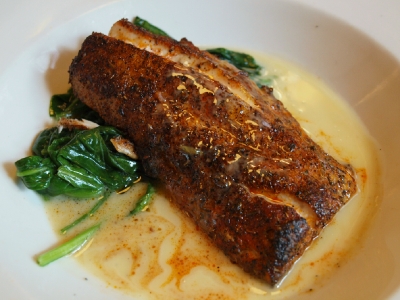
- 1/4 cup white wine
- 1/4 cup olive oil
- 1 Tbs. soy sauce
- 1 Tbs. lemon juice
- 4 large fillets of drum, redfish, or sheepshead, skin and scales on
- 6 Tbs. butter
- 2 Tbs. finely chopped garlic
- 2 Tbs. chopped fresh oregano
- 4 sprigs parsley, leaves only, chopped
- Salt and cracked pepper to taste
1. Mix the wine, olive oil, soy sauce and lemon juice in a broad bowl big enough to fit the fish. Marinate the fish for about a minute, skin side up.
2. Place the fish skin side down on a very hot grill. Mix the garlic, oregano, parsley, salt and pepper into the butter, and spread it on top of the fish.
3. Grill the fish without turning until the very top of the fish is distinctly warm to the touch. It's best when some of the butter falls into the flames and smokes up over the fish. The scales will char
4. Serve with lemon wedges.
Note: depending on the species, cutting fish like this often leaves bones in place. Tell your guests to be aware of that.
Serves four.
[divider type=""]
 May 3, 2017
Today's Flavor
Jazz Festival--Resumes today through May 6 Mother's Day--May 13
Annals Of Restaurant Extinction
Today in 1978, a citywide flood shut down most of New Orleans after over a dozen inches of rain fell in a few hours. The May Third Flood was considered a modern high-water mark until Katrina made it look insignificant. May Third and another flood nearly as bad a year later forced the closing of T. Pittari's Restaurant, after over eighty years. Pittari's was on Claiborne near Napoleon, one of the lowest points in the city. It moved to Mandeville, but didn't make it long there. Now it's an article of nostalgia.
Today's Flavor
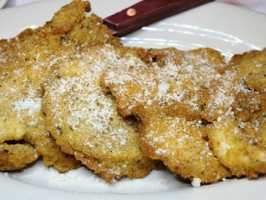
This is National Pannee Meat Day. Like most other Orleanians of Baby Boom age, I grew up eating panneed veal, chicken, and pork. Enough of it to have an article of faith on the subject: even cardboard is good panneed.
Gourmet Gazetteer
Iceberg Island is a half-mile northwest of the lighthouse at Iceberg Point on Lopez Island. It's one of the smallest of a cluster of islands that make up the northwestern extremes of Washington State. The Canadian border is twelve miles west, and the Canadian city Victoria is five miles beyond that. Iceberg Island is a bird sanctuary. No icebergs are likely here, although grooves in the rock indicate heavy glaciation at some time in the past. You won't find any iceberg lettuce for a wedge salad here, either: Iceberg Island is uninhabited. However, you're only seven miles away from Love Dog Cafe on Lopez Island, which can be reached by private boat or ferry.
Food In History
Today in 1944, wartime rationing of meat in the United States came to an end. Many cookbooks and articles had been written to help people get along with less meat. Even the best food writers were engaged in that activity, including M.F.K. Fisher, whose rationing book was How To Cook A Wolf. She and all the other authors of such works had to figure out something else to do.
New World Food
Christopher Columbus first landed on the island that would later be called Jamaica today in 1494. The first time I went to Jamaica, I was struck by how much the food of that country resembles the Creole cooking I grew up with in New Orleans, even though the colonizers were different. Jamaican food, because of its mix of Spanish and British roots and wealth of unusual fruits and vegetables, is utterly unique. Perhaps the most offbeat item is ackee, a fruit related to the cashew. When it ripens it explodes on the tree. When cooked, it looks and sort of tastes like scrambled eggs. But if you eat it before it's ripe, it can kill you.
The Old Kitchen Sage Sez:
Since I can't get Jamaican saltfish and ackee where I live, I guess I'll have to eat scrambled eggs and bacon.
Edible Dictionary
corned beef, n.--Cured beef, usually brisket, cured with a mixture of peppers, herbs and other seasonings. The curing not only alters and adds to the flavor of the meat, but also tenderizes it. The name refers to the resemblance the seasonings have in size and shape to grains of wheat (called "corns" in Great Britain.) Although it's not necessary to achieve the distinctive flavor, nitrates and nitrites are usually used in the cure, which produces the orange-red color associated with corned beef. Corned beef made without those additives is brown.
Food In Show Biz
Today in 1939, the Andrews Sisters recorded yet another hit, Beer Barrel Polka. "Roll out the barrel," said the lyrics, "we'll have a barrel of fun." What innocent times those were.
The Saints
Today is the feast day of St. Philip, one of the twelve Apostles. He is the patron saint of pastry chefs.
Food Namesakes
William Charles Salmon, a Congressman from Tennessee, was born today in 1868. . . Boxer Sugar Ray Robinson was born today in 1920. . . Norman Chow, long-time offensive coordinator in college and pro football, took The Big Snap today in 1946.
Words To Eat By
"The healthiest part of a doughnut is the hole. Unfortunately, you have to eat through the rest of the doughnut to get there."--Randy Glasbergen, American cartoonist, in "Thin Lines."
Words To Drink By
“There are five reasons for drinking: the arrival of a friend, one's present or future thirst, the excellence of the wine, or any other reason.”--Ancient Roman proverb.
Fish On The Half Shell
If you cut big fillets from a redfish or drum and leave the skin and scales on, you can grill it over a hot fire without having to turn it. The skin and scales get black, but the fish stays moist because it's steaming in its own juices. You absolutely must do this outdoors, because the smell of the burning scales in the beginning is not the nicest thing you will ever sniff. (Don't worry--it won't show up in the flavor of the fish.)
- 1/4 cup white wine
- 1/4 cup olive oil
- 1 Tbs. soy sauce
- 1 Tbs. lemon juice
- 4 large fillets of drum, redfish, or sheepshead, skin and scales on
- 6 Tbs. butter
- 2 Tbs. finely chopped garlic
- 2 Tbs. chopped fresh oregano
- 4 sprigs parsley, leaves only, chopped
- Salt and cracked pepper to taste
1. Mix the wine, olive oil, soy sauce and lemon juice in a broad bowl big enough to fit the fish. Marinate the fish for about a minute, skin side up.
2. Place the fish skin side down on a very hot grill. Mix the garlic, oregano, parsley, salt and pepper into the butter, and spread it on top of the fish.
3. Grill the fish without turning until the very top of the fish is distinctly warm to the touch. It's best when some of the butter falls into the flames and smokes up over the fish. The scales will char
4. Serve with lemon wedges.
Note: depending on the species, cutting fish like this often leaves bones in place. Tell your guests to be aware of that.
Serves four.
[divider type=""]
May 3, 2017
Today's Flavor
Jazz Festival--Resumes today through May 6 Mother's Day--May 13
Annals Of Restaurant Extinction
Today in 1978, a citywide flood shut down most of New Orleans after over a dozen inches of rain fell in a few hours. The May Third Flood was considered a modern high-water mark until Katrina made it look insignificant. May Third and another flood nearly as bad a year later forced the closing of T. Pittari's Restaurant, after over eighty years. Pittari's was on Claiborne near Napoleon, one of the lowest points in the city. It moved to Mandeville, but didn't make it long there. Now it's an article of nostalgia.
Today's Flavor
This is National Pannee Meat Day. Like most other Orleanians of Baby Boom age, I grew up eating panneed veal, chicken, and pork. Enough of it to have an article of faith on the subject: even cardboard is good panneed.
Gourmet Gazetteer
Iceberg Island is a half-mile northwest of the lighthouse at Iceberg Point on Lopez Island. It's one of the smallest of a cluster of islands that make up the northwestern extremes of Washington State. The Canadian border is twelve miles west, and the Canadian city Victoria is five miles beyond that. Iceberg Island is a bird sanctuary. No icebergs are likely here, although grooves in the rock indicate heavy glaciation at some time in the past. You won't find any iceberg lettuce for a wedge salad here, either: Iceberg Island is uninhabited. However, you're only seven miles away from Love Dog Cafe on Lopez Island, which can be reached by private boat or ferry.
Food In History
Today in 1944, wartime rationing of meat in the United States came to an end. Many cookbooks and articles had been written to help people get along with less meat. Even the best food writers were engaged in that activity, including M.F.K. Fisher, whose rationing book was How To Cook A Wolf. She and all the other authors of such works had to figure out something else to do.
New World Food
Christopher Columbus first landed on the island that would later be called Jamaica today in 1494. The first time I went to Jamaica, I was struck by how much the food of that country resembles the Creole cooking I grew up with in New Orleans, even though the colonizers were different. Jamaican food, because of its mix of Spanish and British roots and wealth of unusual fruits and vegetables, is utterly unique. Perhaps the most offbeat item is ackee, a fruit related to the cashew. When it ripens it explodes on the tree. When cooked, it looks and sort of tastes like scrambled eggs. But if you eat it before it's ripe, it can kill you.
The Old Kitchen Sage Sez:
Since I can't get Jamaican saltfish and ackee where I live, I guess I'll have to eat scrambled eggs and bacon.
Edible Dictionary
corned beef, n.--Cured beef, usually brisket, cured with a mixture of peppers, herbs and other seasonings. The curing not only alters and adds to the flavor of the meat, but also tenderizes it. The name refers to the resemblance the seasonings have in size and shape to grains of wheat (called "corns" in Great Britain.) Although it's not necessary to achieve the distinctive flavor, nitrates and nitrites are usually used in the cure, which produces the orange-red color associated with corned beef. Corned beef made without those additives is brown.
Food In Show Biz
Today in 1939, the Andrews Sisters recorded yet another hit, Beer Barrel Polka. "Roll out the barrel," said the lyrics, "we'll have a barrel of fun." What innocent times those were.
The Saints
Today is the feast day of St. Philip, one of the twelve Apostles. He is the patron saint of pastry chefs.
Food Namesakes
William Charles Salmon, a Congressman from Tennessee, was born today in 1868. . . Boxer Sugar Ray Robinson was born today in 1920. . . Norman Chow, long-time offensive coordinator in college and pro football, took The Big Snap today in 1946.
Words To Eat By
"The healthiest part of a doughnut is the hole. Unfortunately, you have to eat through the rest of the doughnut to get there."--Randy Glasbergen, American cartoonist, in "Thin Lines."
Words To Drink By
“There are five reasons for drinking: the arrival of a friend, one's present or future thirst, the excellence of the wine, or any other reason.”--Ancient Roman proverb.

A Widely-Used Bit Of Taking The Lord's Name In Vain.
Now it comes to the Mexican food scene.Click here for the cartoon.